

Country: Italy, France
Year: 1964
Duration: 137'
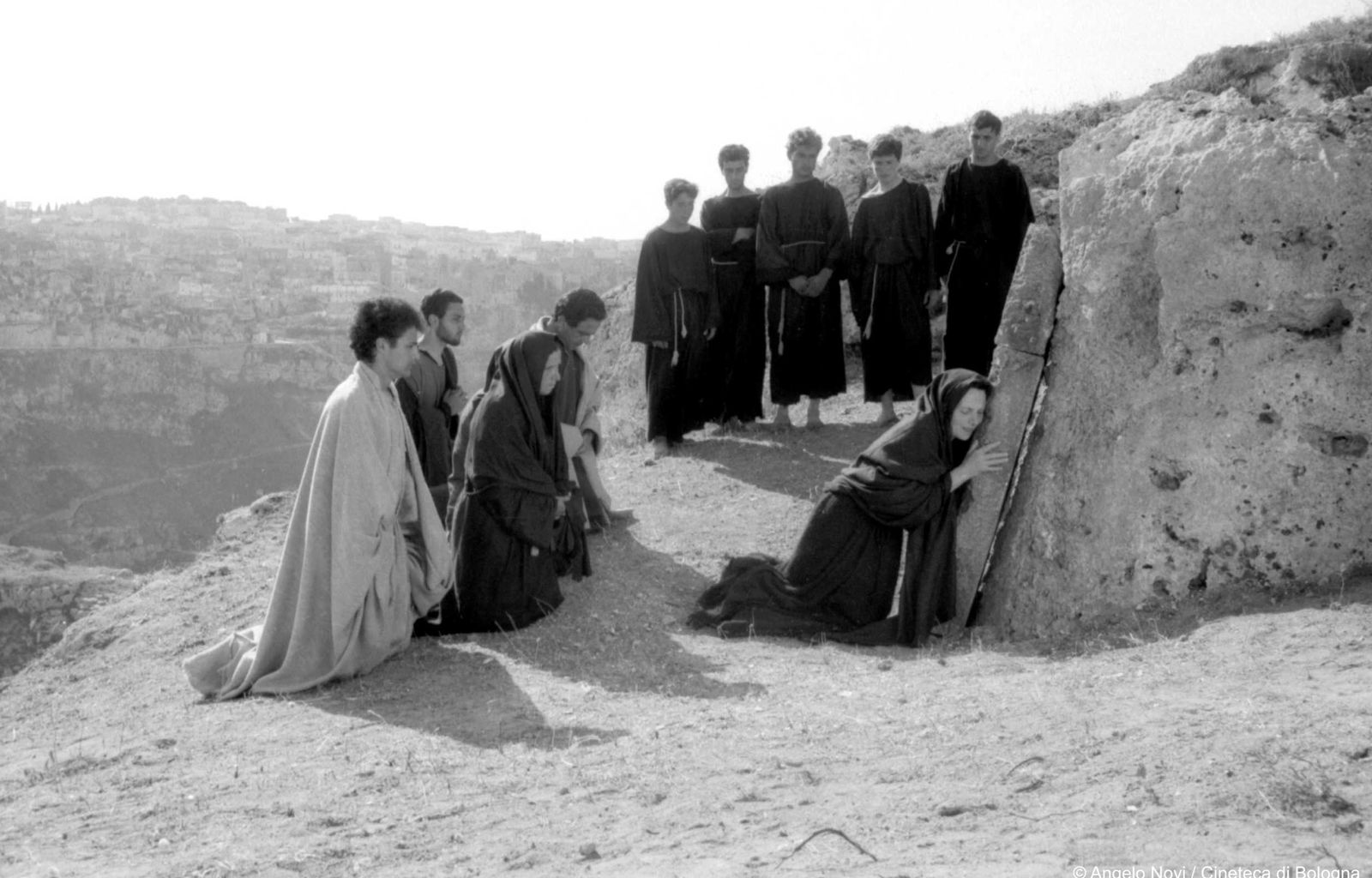
A literal transposition of the Gospel of St. Matthew, starting with the Annunciation to Mary that she will give birth to the son of God, followed by the marriage of Mary and Joseph, and their flight into Egypt to escape Herod. As an adult, Jesus faces the temptations in the desert; after forty days, he heads toward Israel with his Apostles, preaching the holy word and performing miracles. His actions lead to his trial before Pontius Pilate, his crucifixion, and his resurrection. At the height of the conciliatory climate, in the Italy of the economic boom and the growing political tensions that would lead to the events of 1968, Pasolini, a secular person, portrays the life of Jesus, voiding it of all traditional frills, setting the story among the Sassi di Matera, using non-professional actors and many well-known faces (his mother portraying Mary as an elderly woman; his friends Enzo Siciliano, Rodolfo Wilcock, and Natalia Ginzburg), and capturing the extraordinarily modern and overwhelming message.
Biography
film director
Pier Paolo Pasolini
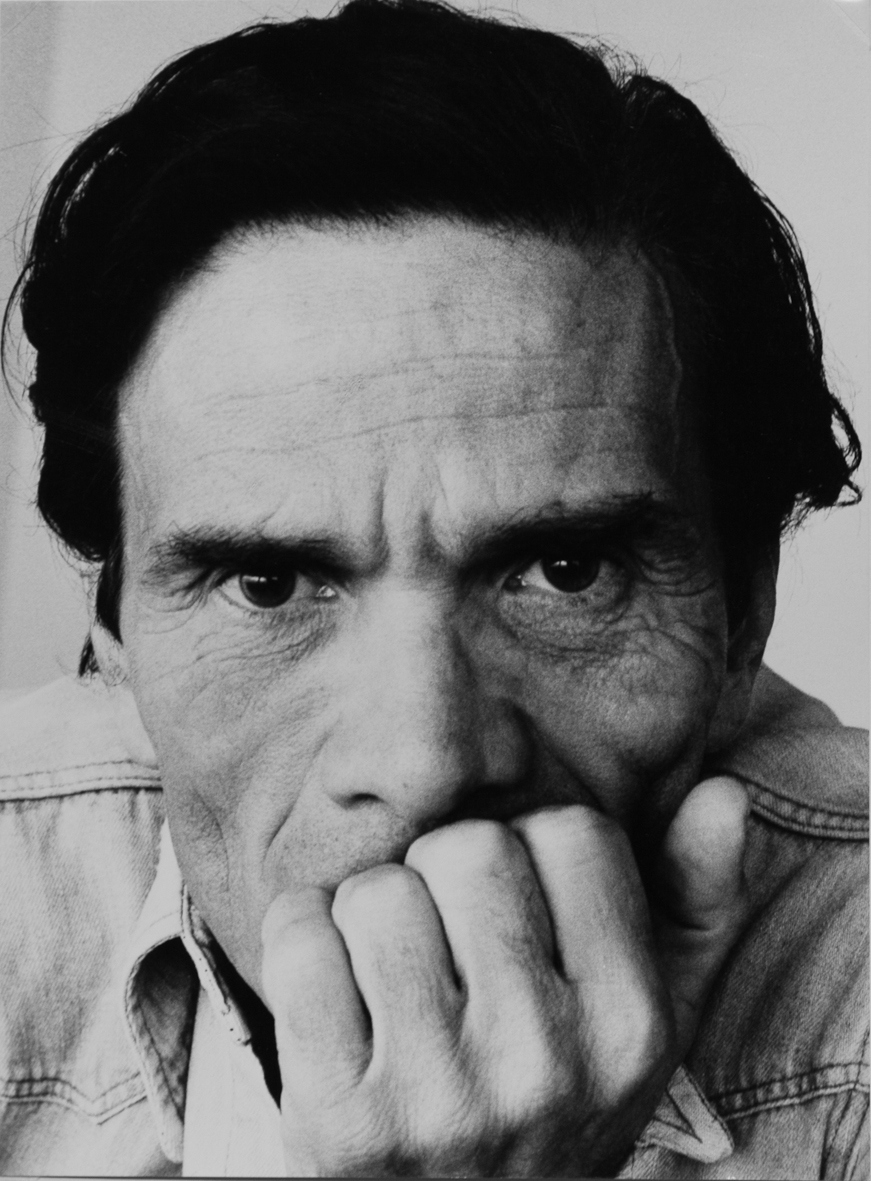
(Bologna, Italy, 1922 - Ostia, Rome, Italy, 1975) published his first collection of poems in 1942, before graduating from university and teaching at a middle school in the province of Udine. He then moved to Rome, where in 1955 he published Ragazzi di vita, which led to the first of a long series of lawsuits. He debuted in cinema in 1961 with Accattone!, presented at Venice, which was then followed by films such as Mamma Roma, The Gospel According to Saint Matthew, Hawks and Sparrows, Oedipus Rex, The Decameron and Salò, or the 120 Days of Sodom, which previewed in Paris in November 1975, three weeks after his death.
FILMOGRAFIA
Accattone (1961), Mamma Roma (1962), Ro.Go.Pa.G. (ep. La ricotta, 1963), Comizi d’amore (tv, doc., 1964), Il Vangelo secondo Matteo (1964), Uccellacci e uccellini (1966), Le streghe (ep. La Terra vista dalla Luna, 1967), Edipo re (1967), Capriccio all’italiana (ep. Che cosa sono le nuvole?, 1968), Appunti per un film sull’India (1968), Teorema (1968), Amore e rabbia (ep. La sequenza del fiore di carta, 1969), Porcile (1969), Medea (1969), Appunti per un’Orestiade africana (1969), Il Decameron (1971), Le mura di Sana’a (1971), I racconti di Canterbury (1972), Il fiore delle Mille e una notte (1974), Salò o le 120 giornate di Sodoma (1975).
Declaration
film director
“The Gospel of St. Matthew is the most epic one of all. To me, of all the Evangelists, he is the most revolutionary because he is the most realistic, the closest to the peasant world in which Christ appeared.”
Cast
& Credits
DIRECTOR, SCREENPLAY: Pier Paolo Pasolini. CINEMATOGRAPHY: Tonino Delli Colli. EDITING: Nino Baragli. PRODUCTION DESIGN: Luigi Scaccianoce, Dante Ferretti. COSTUMES: Danilo Donati. MUSIC: Luis Bacalov (Johann Sebastian Bach, Wolfgang Amadeus Mozart, Sergej Prokofiev, Anton Webern, canti gospel). CAST: Enrique Irazoqui, Margherita Caruso, Susanna Pasolini, Marcello Morante, Mario Socrate, Settimio Di Porto, Alfonso Gatto, Luigi Barbini, Giacomo Morante, Giorgio Agamben, Guido Cerretani, Rosario Migale, Ferruccio Nuzzo, Marcello Galdini, Elio Spaziani, Enzo Siciliano, Otello Sestili, Juan Rodolfo Wilcock, Alessandro Tasca, Amerigo Bevilacqua, Natalia Ginzburg. PRODUCTION: Alfredo Bini per Arco Film, Lux Compagnie Cinématographique de France.
CONTACT: Cineteca di Bologna cinetecadirezione@cineteca.bologna.it